Seed Impact Mills
Seed impact mills are a harvest weed seed control device designed to crush crop residues and chaff material leaving the combine, including weed seeds. There are three major brands in use in North America today: the Integrated Harrington Seed Destructor (iHSD), the Redekop Seed Control Unit, and the Seed Terminator. University testing shows very high weed seed kill rates from seed impact mills, but harvest conditions, crop type, and climate can significantly impact how well they work. Open each accordion below to learn more.
1. How do seed impact mills work?

Mills process only the chaff portion of harvested material, which is what comes off the sieves (also known as the shoe). The straw fraction is not processed. This design is effective because research shows that weed seeds are found predominantly in the chaff. For example, GROW network testing shows less than 5% of weed seeds escape control by exiting the combine in the straw material (see Section 2. How well do seed impact mills kill weed seeds?).
During harvest, chaff material and weed seeds enter the center of the seed impact mill and pass through rings of spring bars or screens (rotors) and stationary bars or screens (stators) to exit the mill. The rotors spin at about 3,000 rotations per minute. Weed seeds must hit the steel four times or more before exiting. Most seeds are shattered into multiple, non-viable fragments. Sometimes whole seeds pass through with fatal damage to internal organs, leaving them non-viable. In other cases, seed coats are cracked, exposing seeds to elements and pathogens, which significantly lowers germination potential.
See a short video demonstrating how seed impact mills work with a Redekop model:
For another system, here’s a look under the hood of the Seed Terminator’s twin mills (video by Michael Flessner, Virginia Tech). When operating, chaff and weed seeds enter the top center of the two mills and pass through the rings of spinning (rotors) and stationary (stators) screens. Chaff and weed seeds hit the steel screens at least four times before exiting, killing weed seeds and breaking chaff into even finer pieces:
Another seed impact mill currently under development is the WeedHog from Tecfarm Engineering in Australia. It works differently than other options on the market but has not yet been tested in the United States.
2. How well do seed impact mills kill weed seeds?
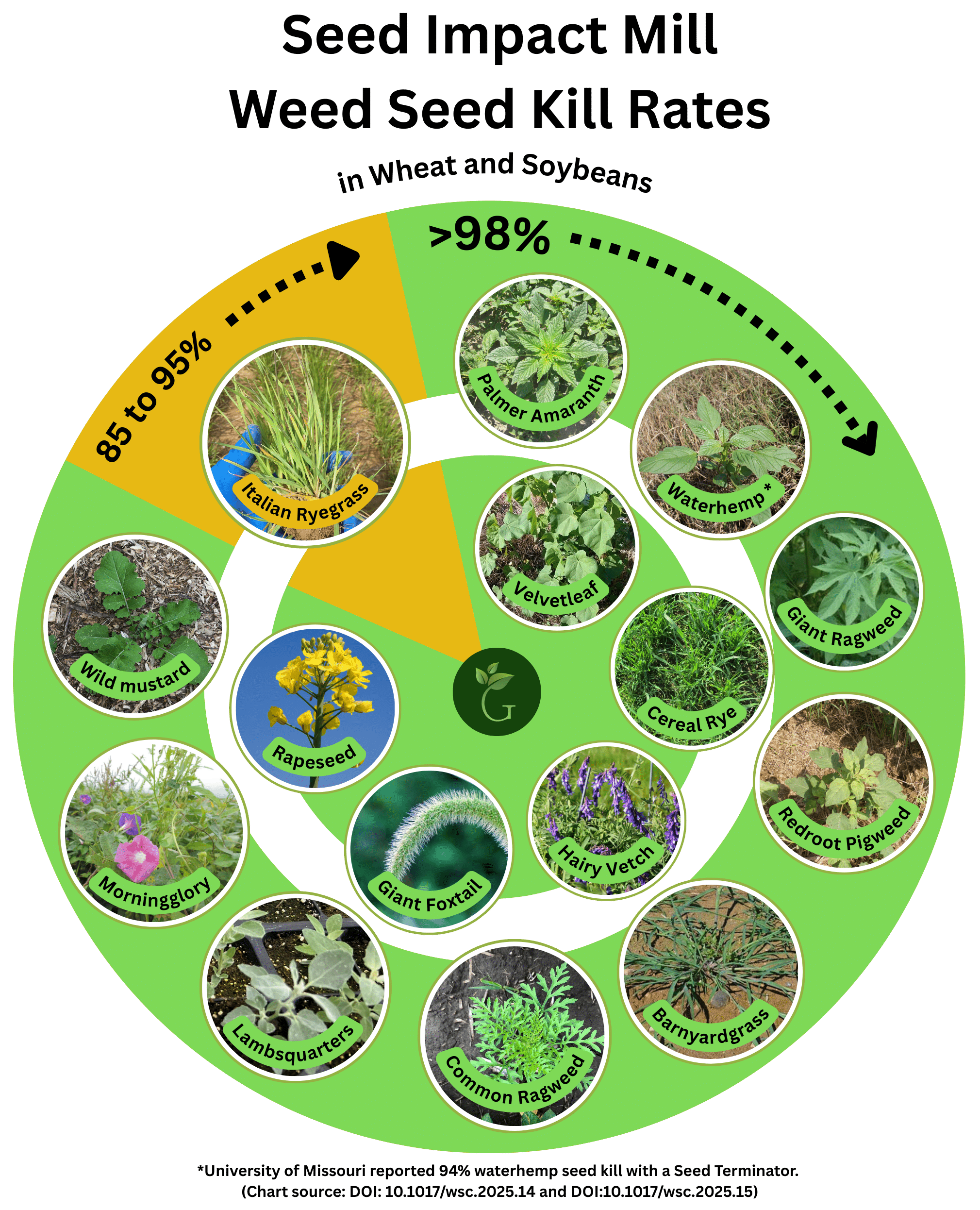
Seed impact mills have a very high kill rate, typically greater than 98% for most weed species evaluated. One exception is Italian ryegrass, which showed kill rates of 85–95% in university testing (Figure 2). Research shows that seeds not completely killed by seed impact mills will likely not survive the winter. Crop seed is also controlled by the mills, leading to reduced issues with volunteers.
Various factors can influence seed kill rate including the crop harvested, chaff flow rate into the mill, and the chaff material’s moisture level. However, the impact of these factors is minor– typically, seed kill rates change by less than 1% under varying conditions.
One type of seed impact mill has a feature that can affect seed kill rates. The Seed Terminator offers different screen options inside the mills, allowing for varied chaff flow and power usage. Options include:
- High seed-kill-rate screen — highest kill rate, uses the most horsepower, lowest chaff capacity.
- Low (50%) seed-kill-rate screen — lowest horsepower requirement, highest chaff capacity.
- Intermediate screen options offering a balance between the two.
3. How do seed impact mills affect combine performance?
Farmers generally report that adding a seed impact mill reduces a combine’s capacity by one class. So, if you install one on a Class 8 combine, you can expect performance closer to a Class 7. As a result, Class 8 or larger combines are recommended for use with seed impact mills. Class 7 combines can be used, but operators should expect to run out of horsepower and reduce speed. Many factors influence combine performance, including crop type, yield, harvest conditions (especially moisture), and combine settings such as rotor speed and clearance.
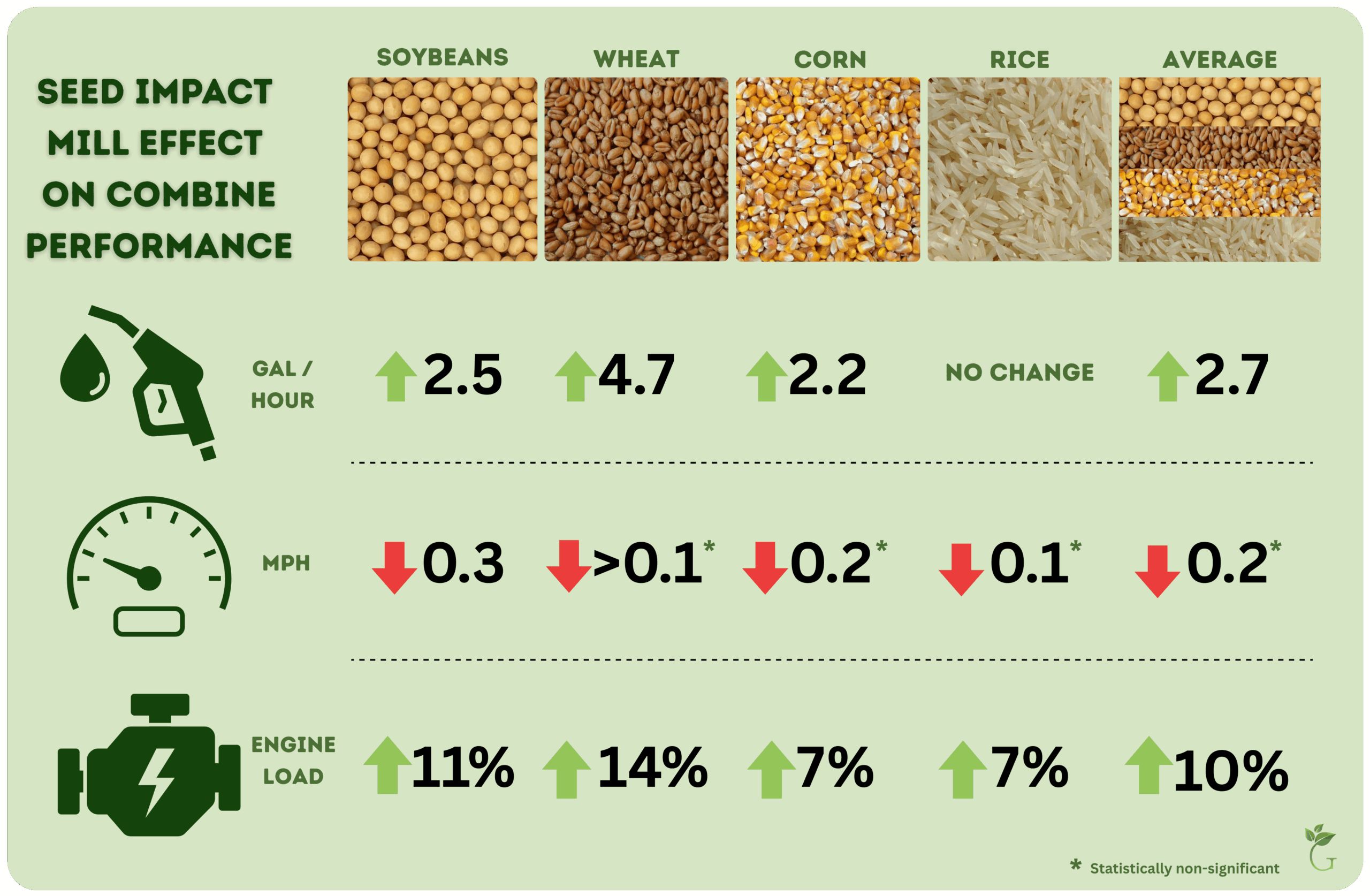
A seed impact mill will result in about 2.7 gallons per hour higher fuel consumption, 9.7% increased demand on engine capacity, and a 0.2 mph reduction in travel speed, according to GROW testing across corn, rice, soybean, and wheat under various harvest conditions, combine setups, and both Redekop SCU and iHSD seed impact mills (see Figure 3).
Seed impact mills currently on the market can be bypassed, but switching between “on” and “off” is not a simple push of a button. Operators should expect a 5–20 minute delay to reconfigure between running and bypassing modes.
4. What are the costs of operating a seed impact mill?
Purchase price is typically around $70,000. This cost can vary depending on seed impact mill brand, combine model, and any fitting parts required for installation.
Installation costs are also variable but typically range from $2,000 to $4,000. Some dealers may include installation with the purchase, while others allow farmers to perform installation themselves. A typical setup takes about one to two days.
Operating expenses include increased fuel consumption and routine maintenance. Fuel use typically increases by about 2.7 gallons per hour when the mill is running. The mill’s internal parts wear down over time and will need replacement based on usage. Soil type can influence wear rates—harvesting in sandy soils, for example, can accelerate wear and reduce mill life expectancy. Farmer reports also indicate that canola is one of the toughest crops on mills, reducing component lifespan compared to other crops.
5. How do clogs and other mechanical issues affect the mills?
Seed impact mills perform best in dry harvest conditions, typically in low rainfall areas similar to Western Australia where the equipment was first developed.
Green harvest materials are the enemy of seed impact mills due to their high moisture content. Harvest residues need to be sufficiently dry to avoid plugging or damaging the mills or increasing horsepower consumption. Grain moisture is not a good indicator of chaff moisture. Problematic moisture can come from other parts of the crop, such as green stems in soybeans, or from weeds present in the field, such as purple ammannia in rice, pigweeds in soybean, or kochia in wheat.
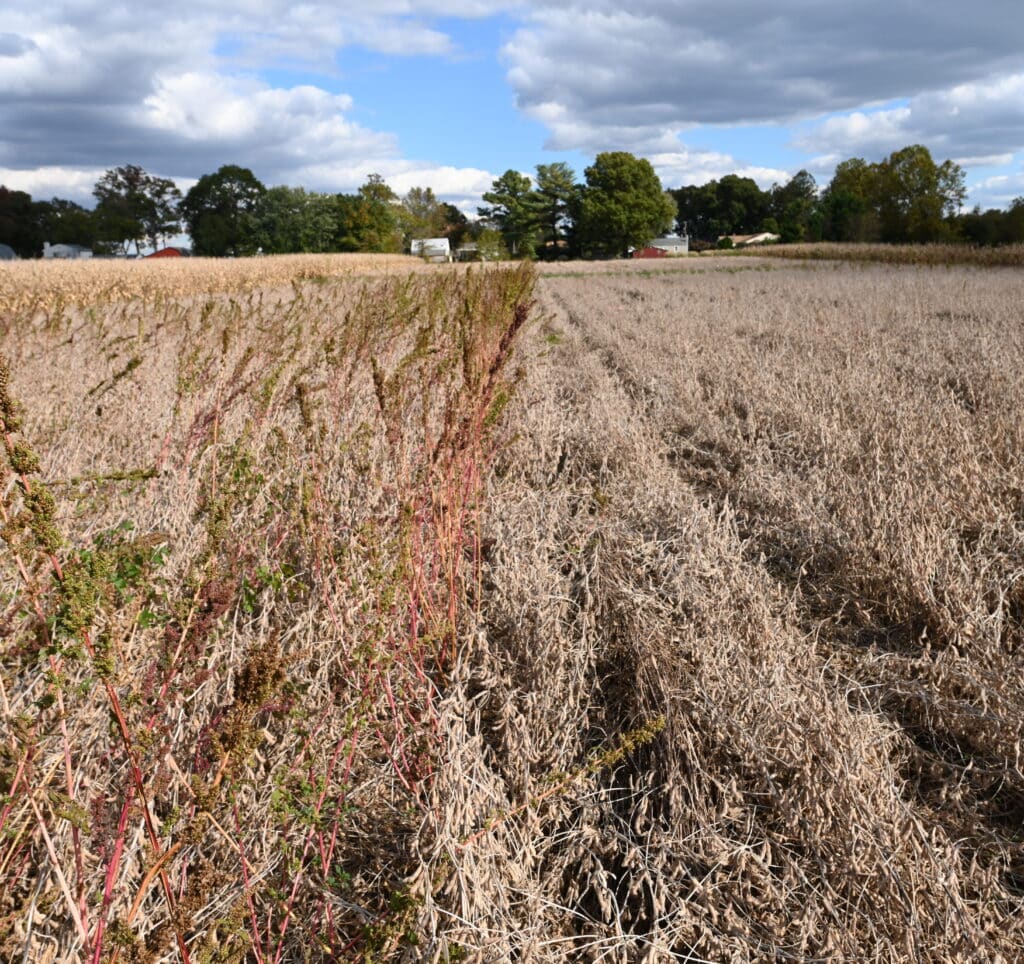
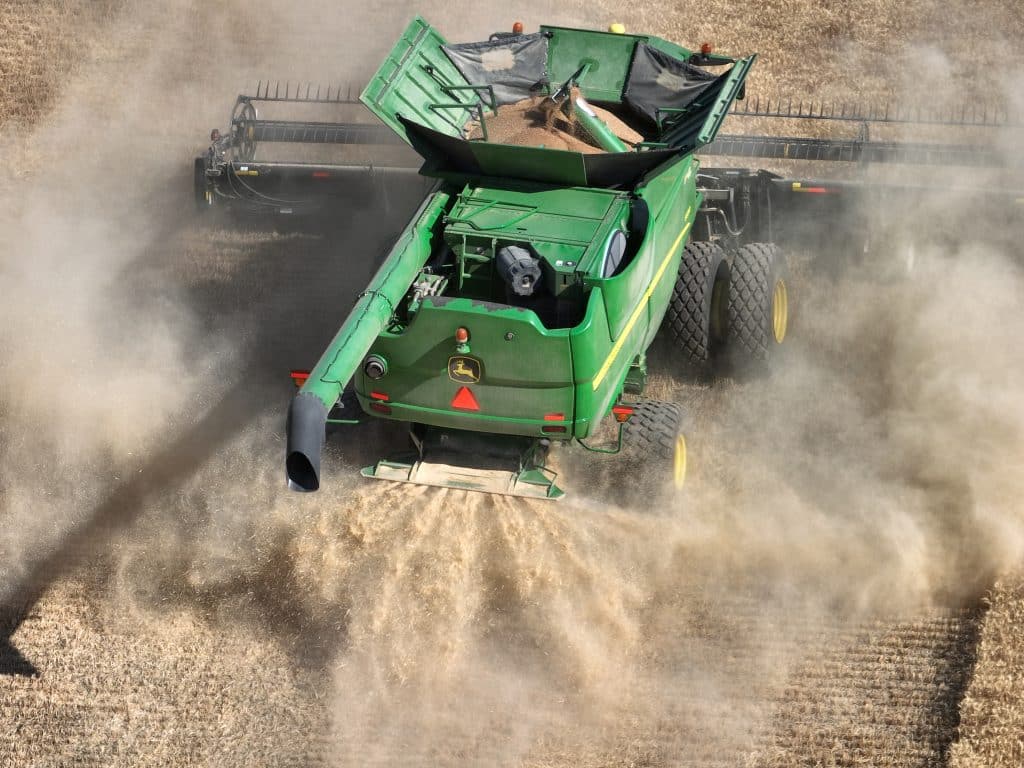
Some farmers have experienced plugging the combine with harvest material while operating seed impact mills (Figure 4). In GROW testing, farmer cooperators had this problem in excessively weedy fields when the weeds were still green at harvest or early in the harvest season when moisture levels were higher. Harvesting corn with high moisture in the stems and leaves led to damaging a seed impact mill. These clogs and damaged units have led some farmers to discontinue seed impact mill use.
Potential solutions to high moisture harvest conditions include swathing, chemical desiccation, leaving weedy patches to be cleaned up at the end of harvest, or delaying harvest until drier conditions prevail.

Check out this Farmer Forum on dealing with green residues:
Metal parts like nuts and bolts are another common enemy of a seed impact mill. A single nut that works loose and enters the mill can result in catastrophic failure requiring replacement or major, expensive repairs. Rocks can also cause excessive wear and damage. To alleviate this issue, the Seed Terminator includes a magnetic strip and the iHSD uses a rock trap.
Lastly, since seed impact mills kill crop seed sieve loss, physically measuring yield loss is more difficult when a seed impact mill is installed.
Check out these farmers’ experiences:
For an expanded overview of all harvest weed seed control methods, return to the Harvest Weed Seed Control page.
Authors
Michael Flessner, Virginia Tech
Eli Russell, Virginia Tech
Emily Unglesbee, GROW
Editors
Claudio Rubione, GROW
Mark VanGessel, University of Delaware
Reviewers
Breanne Tidemann, Agriculture and Agri-Food Canada
Lovreet Shergill, Colorado State University
Citations
Bennett AJ, Yadav R, Jha P. Using soybean chaff lining to manage waterhemp (Amaranthus tuberculatus) in a soybean–corn rotation. Weed Science. 2023;71(4):395-402. https://doi.org/10.1017/wsc.2023.34
Broster JC, Walsh MJ, Chambers AJ (2016) Harvest weed seed control: the influence of harvester set up and speed on efficacy in south-eastern Australia wheat crops. In ‘20th Australasian weeds conference Perth, Western Australia’. (Eds R Randall, S Lloyd, C Borger) pp. 38–41. (Weeds Society of Western Australia)
Flessner, ML, Russell, E., Bagavathiannan, M,, Bejleri, K, Chu, S, Crane, W, Law, E, Mirsky, S, Sarangi, D, Shergill, L, VanGessel, M (2025) Combine Performance Metrics While Using a Seed Impact Mill. 24, p. 72-73: https://wssa.net/wp-content/uploads/WSSA_2025-abstracts_6.20.25.pdf.
Rubione, C, VanGessel, M, Scott, B, Johnson, Q (2020) Chaff lining in a soybean field for Palmer amaranth management. GROW Bulletin 03, 5 pages https://growiwm.org/wp-content/uploads/2020/09/GROW-FS-03-Chaff-Lining-Demo-final-4.pdf
Russell EC, Flessner ML. Evaluating weed seed kill efficacy and horsepower draw of two impact mills for use in soybean production. Weed Science. 2025;73(1):e43. https://doi.org/10.1017/wsc.2025.14
Russell EC, Flessner ML. Evaluating two impact mills seed kill efficacy and horsepower draw for use in U.S. wheat production. Weed Science. 2025;73(1):e41. https://doi.org/10.1017/wsc.2025.15
Shergill LS, Bejleri K, Davis A, Mirsky SB. Fate of weed seeds after impact mill processing in midwestern and mid-Atlantic United States. Weed Science. 2020;68(1):92-97. doi:10.1017/wsc.2019.66 https://doi.org/10.1017/wsc.2019.66
Tidemann, B.D., Harker, K.N., Beckie, H.J., Kubota, H., Zuidhof, J. and Reid, P., 2023. Field testing of a physical impact mill in the Canadian Prairies. Canadian Journal of Plant Science, 104(2), pp.103-114.https://doi.org/10.1139/cjps-2023-0091
Winans T, Massey R, Schreier H, Bish M, Bradley KW. Harvest weed seed control in soybean with an impact mill. Weed Technology. 2023;37(2):113-122. https://doi.org/10.1017/wet.2023.20