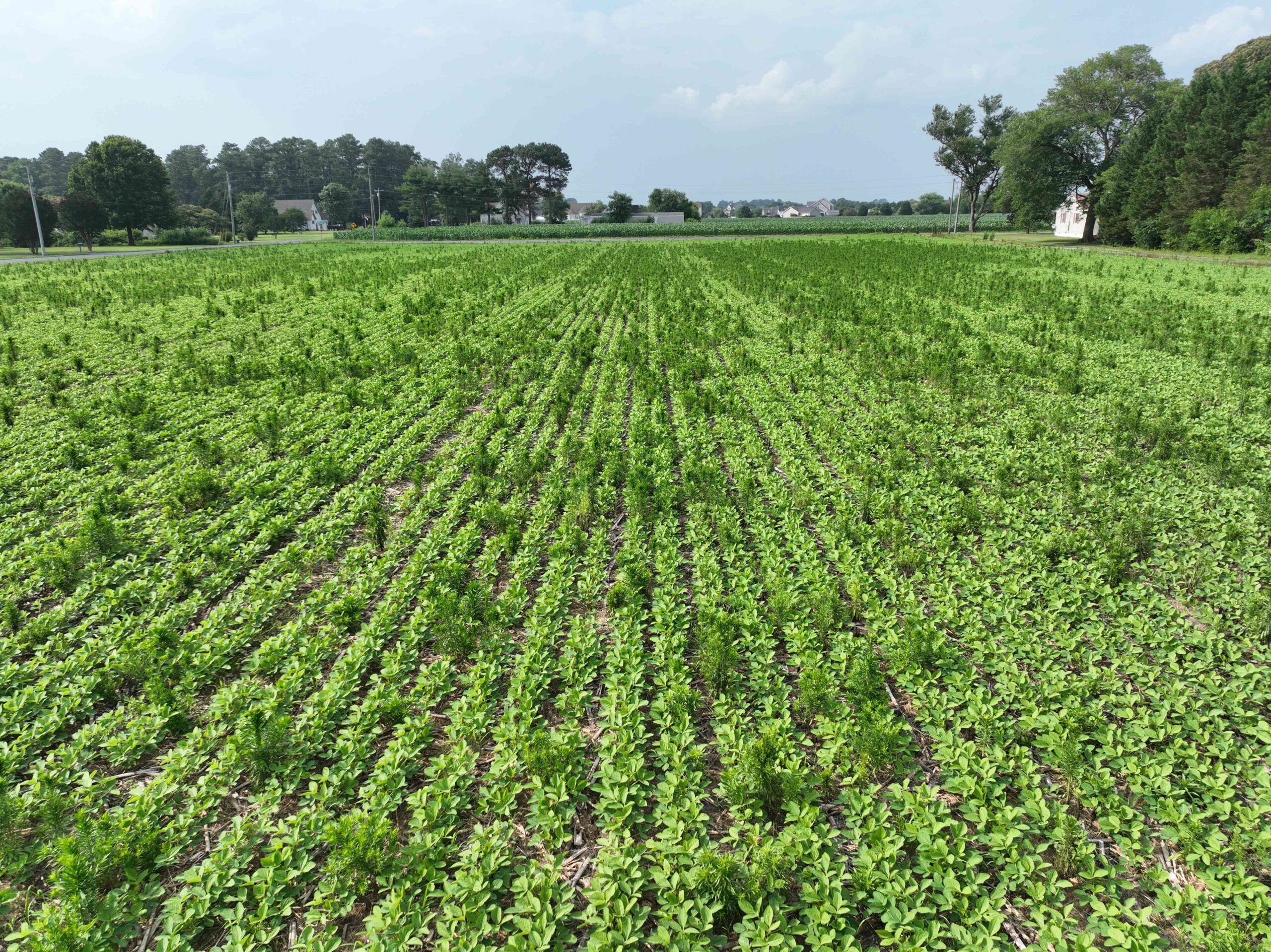
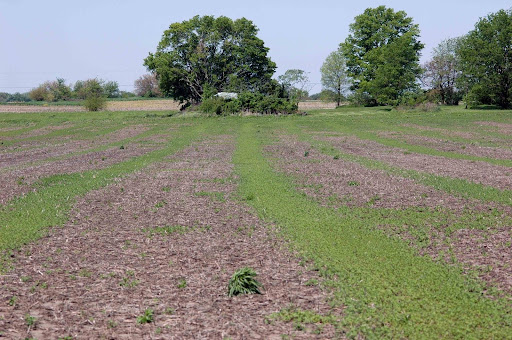
A cover crop stand bursting with 5,000 lbs per acre of biomass can be a boon for weed suppression. But how do you know when your cover crop has met that threshold?
Here are a couple methods for sampling cover crop biomass that anyone can do, from weighing and measuring dried biomass samples, to quick, on-the-run estimations.
In-Depth Sampling for Cover Crop Biomass
Getting a fairly precise estimation for your cover crop biomass isn’t hard, but it does take a few days and some patience.
What you’ll need:
- A rectangular measuring device (called a quadrat)
- Clippers, or other cutting tools
- Paper bags
- A scale
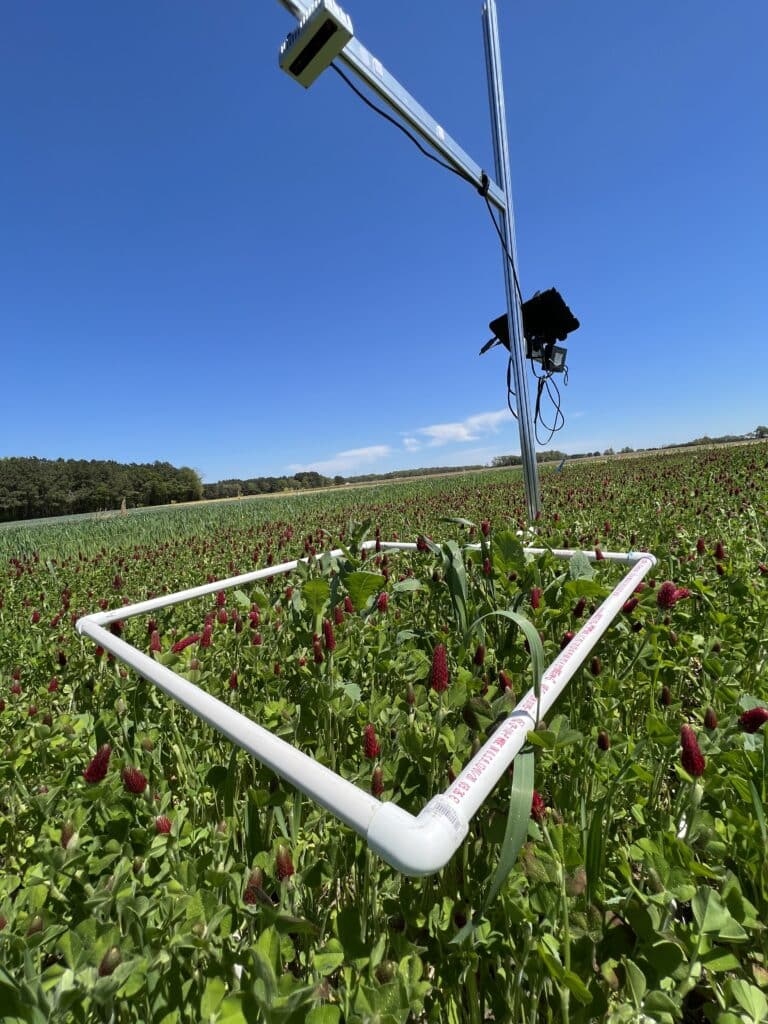
To begin, use a ruler and any available materials (such as four PVC pipes or wooden rods) to create a measuring “square” (called a quadrat). You will measure only the cover crops inside the quadrat. Ideally your quadrat should be a square yard.
If you drilled your cover crops, the width of your quadrat should be some multiple of your row width. For example, a quadrat for measuring the biomass of rye drilled in seven-inch rows should be 14, 21, 28, or 35 inches wide. A one-square-yard quadrat is 14 inches wide by 93 inches long.
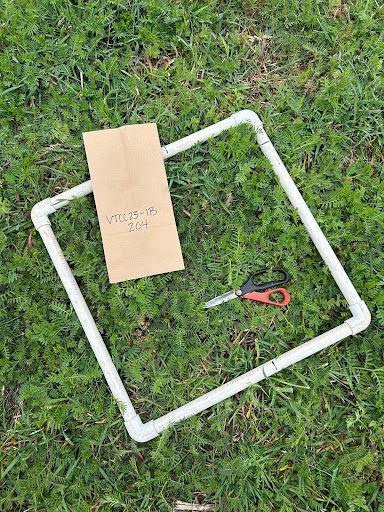
Now that you’re armed with a quadrat, grab a pair of clippers and some paper bags and head into the field!
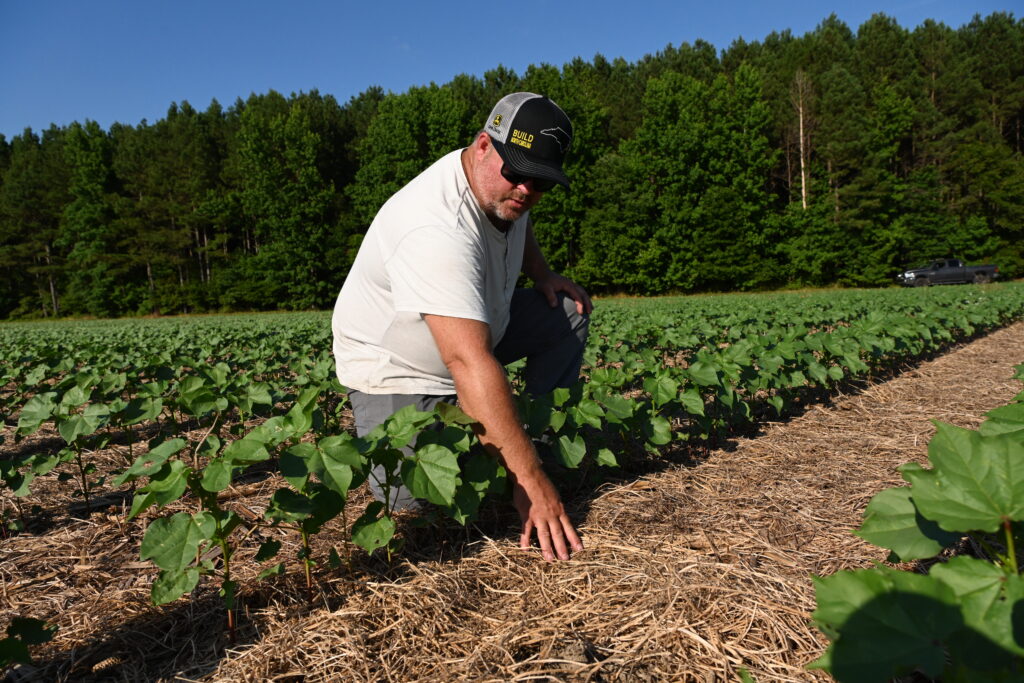
Locate areas of your cover crops that are good representations of the field. Don’t choose an area with sparse cover crops or along the field edges, nor an unusually lush spot. Lay the quadrat down so that the long edge is between two rows, and cut only the cover crops inside of the quadrat close to the ground.
Do you broadcast your cover crops instead of drilling them? Locate the most representative spots in your cover crop field, and make sure the quadrat is snug against the ground before you cut the cover crops inside of the quadrat, including any leaves overhanging from plants outside of the quadrat.
Place all of your collected cover crop clippings in a paper bag. If you have a legume in your mix and want to quantify the amount of nitrogen available, put the legume species in its own paper bag and weigh it separately.
Now the cover crop clippings need to dry for an accurate biomass calculation.
Take your clippings to a dry area, lay them out on a paper surface (not plastic so they don’t rot), and wait! It usually takes five to seven days for the cover crops to completely dry out.
Once dried, the clippings are ready to be weighed on a scale. Place one cover crop species’ clippings into a dish and record their weight. Be sure to note the weight of the dish and subtract that from the total weight. Repeat for each cover crop species.
The last step is to convert each weight and quadrat size (such as pounds per square yard) into pounds per acre or kilograms per hectare and find out where your cover crop biomass ranks. Kyle’s converter is a trusted calculator for converting measurements into desired units, and Iowa State and the University of Georgia have handy conversion charts for this task.
This video by University of Delaware Extension weed specialist Dr. Mark VanGessel gives a visual walkthrough of how to collect cover crop biomass.
Quick Estimation of Cereal Rye or Triticale Cover Crop Biomass
Don’t have days of drying time to spare? Another method from USDA-ARS scientist Dr. Eric Brennan helps you generate a rough estimate of cereal rye or triticale biomass in a much shorter timeframe.
What you’ll need:
- Tape measure, yardstick or meter-long ruler
- A way of keeping measurement notes
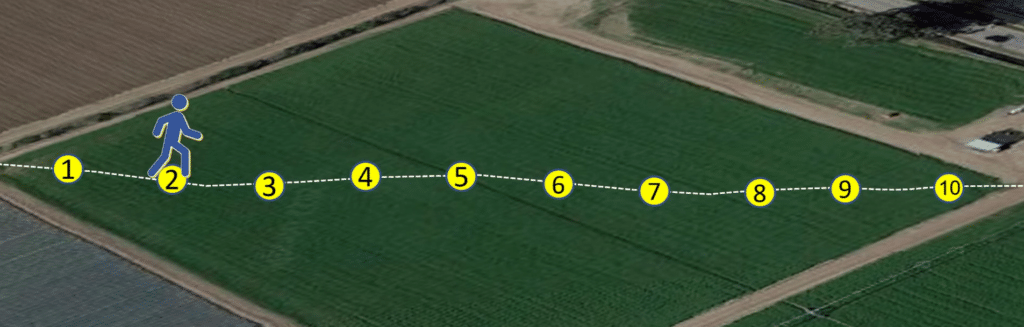
Head out to your field of cover crops and choose an angle to walk through the entire field diagonally.
As you walk through your field, uproot a cereal rye or triticale plant at random every acre or so. Measure each uprooted plant from the base of the main stem (where the stalk meets the roots), to the tip of the main stem. Use centimeters to measure main stem length.
If your cover crop’s main stem is bent, hold it straight against the ruler for an accurate measurement.
Finally, calculate the average plant length by adding each length together and then dividing by the total number of plants measured. Use the graphs below to roughly estimate that field’s cereal rye or triticale biomass in pounds per acre by finding the averaged length along the horizontal axis and plotting it along the line in the graph that corresponds to pounds per acre (right vertical axis) or kilograms per hectare (left vertical axis). This method and the charts below are based off of the Merced cereal rye and Pacheco triticale varieties.
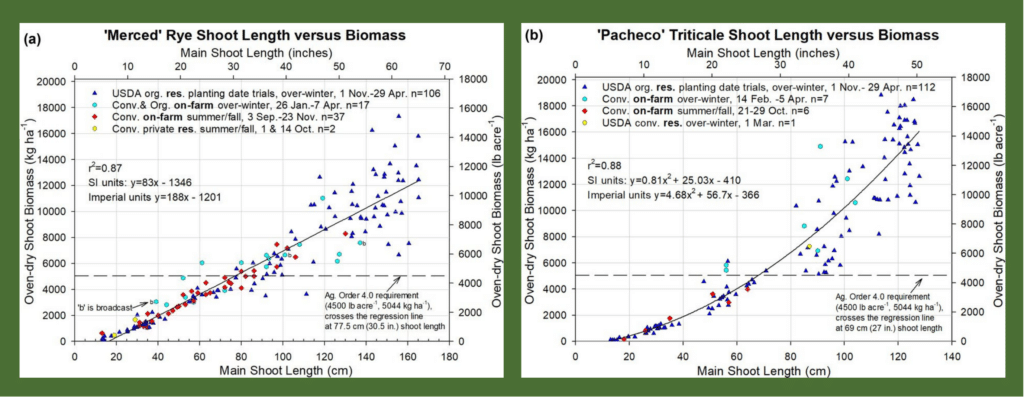
For example, cereal rye with an average main stem length of 100 centimeters correlates to approximately 7,000 pounds per acre of biomass.
Watch Brennan explain this method, and the research behind it, in this video.
Now it’s time to arm yourself with the necessary tools and materials and head out to the field before termination to find out how much biomass your cover crops accumulated this spring!
Explore GROW’s website for more information about cover crop management and termination.
Article by Amy Sullivan, GROW; Header and feature photo by Claudio Rubione, GROW.