Spray drones for weed control have flooded the market with promises of spot spraying, herbicide savings, and late season herbicide applications. Questions remain, however, on how to legally, effectively and safely apply herbicides with drones.
Fortunately, a team of researchers recently analyzed several drone-based studies and came away with five major takeaways for farmers and agribusinesses who adopt this rapidly evolving herbicide application method, according to Kansas State weed scientist Dr. Jeremie Kouame. Kouame’s takeaways also emphasize how operators must balance drone-optimizing adjustments with what each herbicide label allows.
1. Always Follow the Label
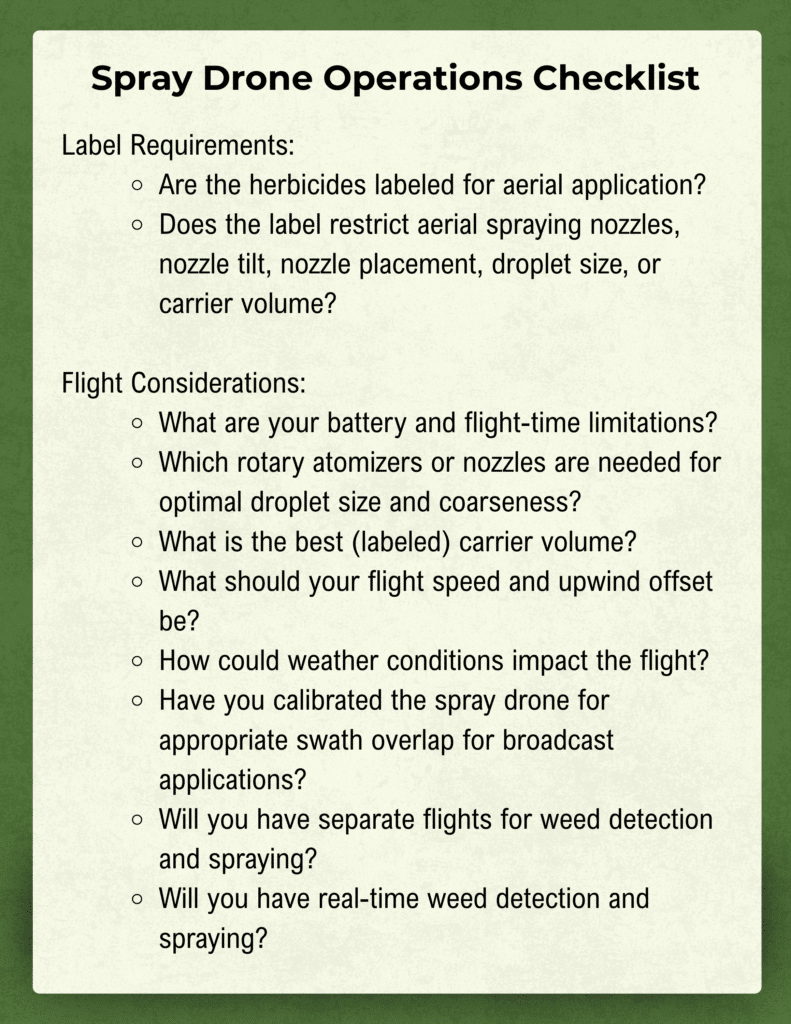
Only herbicides labeled for aerial application can be used in drone sprayers. Kouame’s research uncovered several ways that drone applications could be optimized, but current herbicide label limitations may prohibit operators from adopting some of them right now. Labels, for instance, can restrict:
- Aerial application carrier volumes
- Aerial application herbicide droplet size
- What nozzles and nozzle tilts are allowed for aerial applications.
- How the nozzles are placed in relation to the aircraft’s prop.
These specifications change from label-to-label, and drone operators must follow each herbicide’s label instructions for legal applications. The labels are highly restrictive towards drones for now, but Kouame notes that there is growing momentum for EPA to establish drone-specific herbicide label requirements.
2. Carrier Volumes Alter Spray Coverage and Herbicide Concentration
Large carrier volumes from traditional ground sprayers typically improve herbicide coverage, but drone carrier volumes are limited by tank size. Where ground sprayers allow up to 21 gallons per acre, drones average roughly 4.8 gallons per acre.
However, reducing drone herbicide carrier volumes to as low as 0.9 gallons per acre and increasing droplet size resulted in more concentrated herbicides reaching weeds, Kouame found. Lower drone herbicide carrier volumes sometimes even improved weed control with contact herbicides, which typically require high carrier volumes to thoroughly coat the weeds.
However, keep in mind that current aerial application instructions typically require carrier volumes starting at 2 gallons per acre.
3. Adjust Your Swath for Drone-Applied Broadcast Herbicides
Smaller herbicide tanks aren’t the only differences between drones and traditional boom sprayers. Even the herbicide spray pattern (called a spray swath) is different.
Drone sprayers deposit most of their herbicides directly underneath the nozzle, a pattern known as a bell curve. Herbicide deposition – the amount of active ingredient that reaches its weedy target – reduces as the swath gets further outward. This spray pattern means that broadcast drone applications require overlapping passes to drench all weeds in the sprayed herbicides.
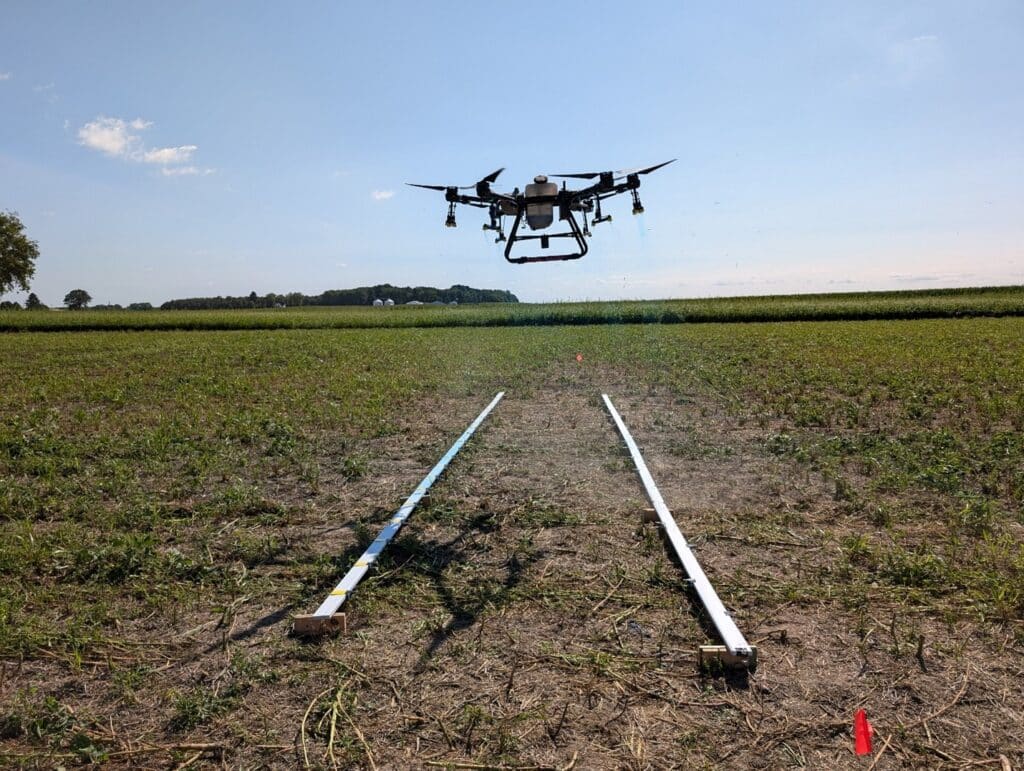
But finding the right spray swath overlap isn’t as simple as moving the drone’s joystick around a bit. Operators must calibrate their drone’s spray swath and nozzle flow rates in-field using spray cards, Kouame explains. This Purdue guide helps drone operators calibrate their spray drones for herbicide applications.
4. Understand Drone Herbicide Drift
“Off-target [herbicide] movement is really important to consider,” Kouame says.
You might have an easier time listing out which factors don’t impact droplet size and drift than the factors that do, he admits. Nozzle selection, spray pressure, nozzle layout on the drone, adjuvants, herbicide formulation, and downwash all alter droplet size and drift.
A drone’s herbicide drift reaches non-detectable levels a lot sooner than spray drift from a plane. But drones still have two-to-five times more drift than a traditional boom sprayer.
Wind speed is the number one factor that determines herbicide drift, even with drones that fly lower and slower than cropdusters. Kouame’s research compiled several different ways that drone operators can reduce drone herbicide drift:
- Use nozzles that produce large, coarse droplets.
- Fly slowly (such as 3 feet per second).
- Spray upwind of weeds to reduce off-target drift.
- Tilt your spray nozzles to accommodate any drone flight tilt.
Downwash – the downward winds generated by the drone’s rapidly spinning propellers – also reduces spray drift and can potentially even improve broadcast herbicide coverage by moving the crop canopy and weeds around.
5. Plan Your Flight Methods Carefully
Typically, drone operators either make two separate flights for weed detection and herbicide spraying, or one flight with near real-time weed detection and spraying. Both systems have their pros and cons.
Separating flights for weed detection and herbicide application is the most common drone-spraying practice, and it helps the operator identify and directly target weeds in the field, at the cost of downtime for weed analysis in between flights.
Real-time weed detection is less common, but could allow the operator to detect and spray weeds in the same flight. This method comes at the cost of draining more battery while flying a loaded sprayer over the field searching for weeds.
No two drone weed detection software are the same, but most rely on differences in a weed species’ features to distinguish between weeds and the crop. Algorithms typically struggle to detect weeds that mimic the crop they grow in, such as barnyardgrass and sprangletop in rice. Drone spot spraying may not be hampered by weed mimicry for long, though. Texas A&M researchers are already developing detection models to differentiate between barnyardgrass, sprangletop, and rice. (Read more about this research in this GROW news article).
Improved target-spray weed detection algorithms can result in herbicide savings for farmers. Research has found that from fallow fields to corn and rice productions, targeted spraying with drones keeps more herbicides in the tank when compared to backpack sprayers. But like everything else with drone-applied herbicides, multiple factors including flight height, flight speed, crop growth stage, and imaging drone camera for prescription map generation will influence herbicide savings, notes Kouame. High resolution cameras (1.4 millimeters per pixel, for instance) will greatly improve weed detection and spot spray accuracy, keeping more herbicides in the tank.
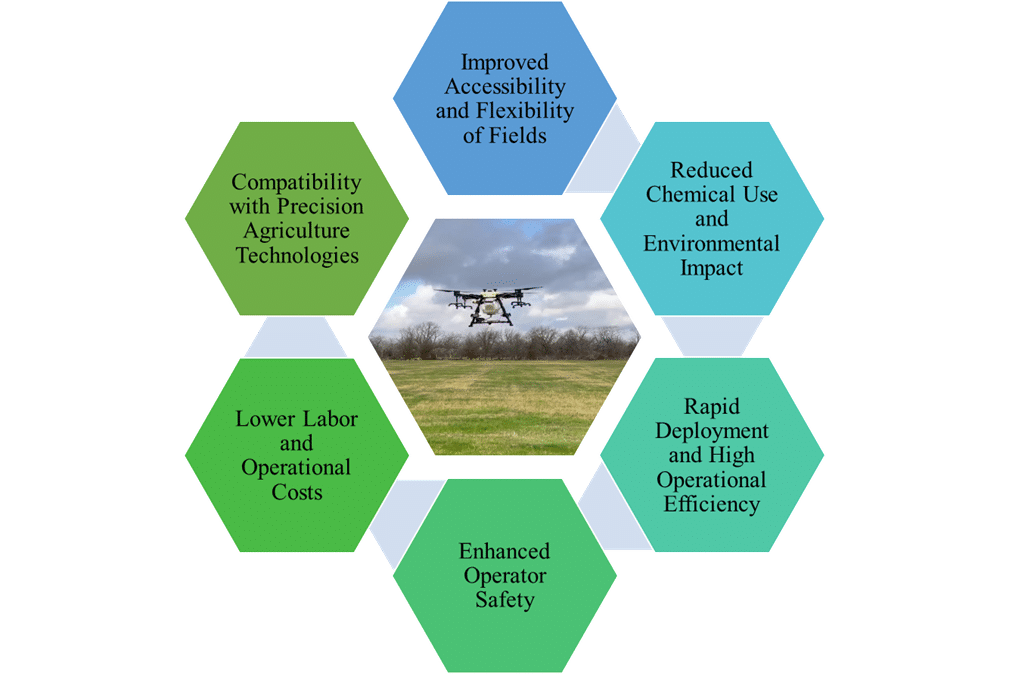
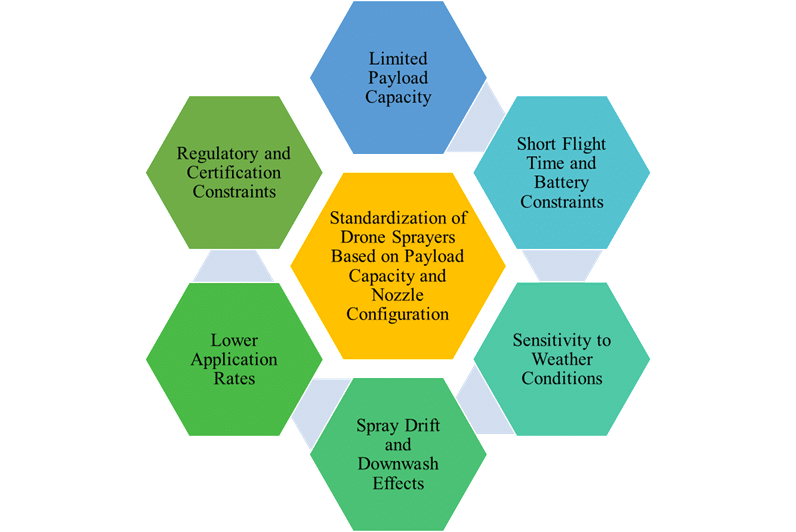
Ultimately, spray drones are a promising addition to farmers’ herbicide application toolkit, but research and regulation are still playing catch up, Kouame concludes.
“Spray drones won’t replace ground equipment, but they are good complements,” he says.
Article by Amy Sullivan, GROW; Header photo by Bholuram Gurjar, Texas A&M; Feature photo by Tommy Butts, Purdue University.